Why 70% of 5-Year Fixed Borrowers Face Surprise Penalties Before Maturity
When most Canadian homeowners sign a 5-year fixed mortgage at a major chartered bank, they spend hours negotiating down 10 or 15 basis points on the contract rate while skipping over the two paragraphs buried in the commitment letter that govern early discharge penalties. Because everyone expects to hold their home or stay put for the full 60 months, prepayment language feels harmless on closing day.
In reality, national mortgage lifecycle data consistently shows that roughly 70% of Canadian borrowers break, refinance, or port their 5-year fixed mortgage before month 36. Whether triggered by a growing family outgrowing a townhome, a divorce buyout, job relocation between provinces, or consolidating high-interest debt, breaking early at a Big Six bank frequently produces a penalty bill exceeding $18,000 to $26,000.
Quick Answer & Key Takeaways (November 2026 Penalty Audit)
- ✅The Posted-Rate IRD Multiplier: Chartered banks subtract your original posted-rate discount from today's 2-year or 3-year posted rate, artificially inflating Interest Rate Differential (IRD) gaps up to 4.00% of principal.
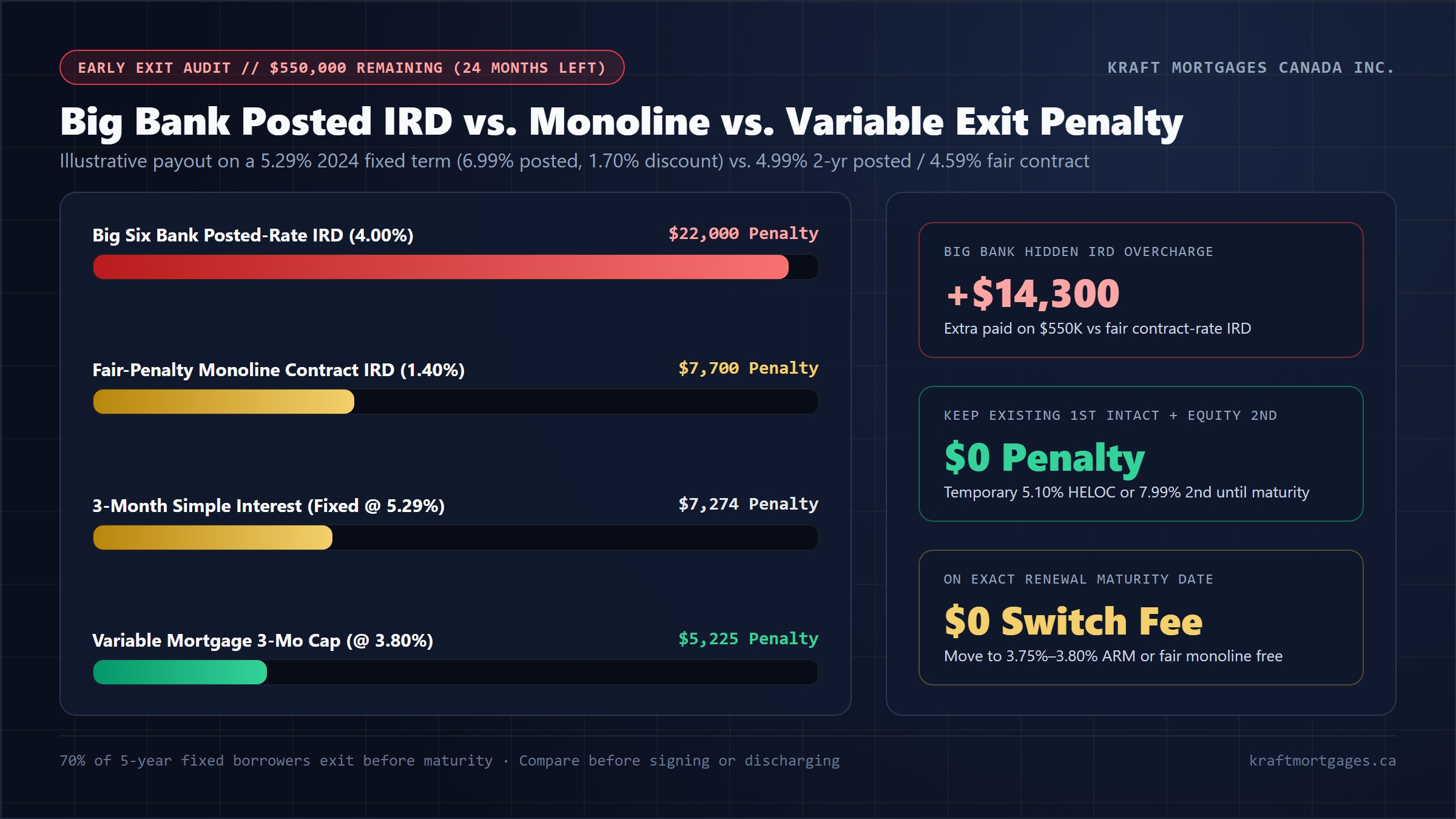
- ✅Real $550,000 Comparison (24 Months Left): A 2024 5.29% fixed mortgage carries a $22,000 Big Bank posted-IRD penalty vs. $7,700 at a fair-penalty monoline vs. $5,225 (3 months interest) on a 3.80% variable mortgage.
- ✅Why Late 2026 Hurts Bank Borrowers: Households who locked 5.00% to 5.49% fixed terms in 2023–2024 sit squarely inside peak IRD territory when exiting today.
- ✅Smart Exit Alternatives: Before paying cash to break a mortgage, evaluate blend-and-extend resets, bona-fide sale ports, or a temporary 7.99% equity second / 5.10% HELOC to wait out the remaining months.
- ✅Prevention at Renewal: On your maturity date, switch penalties drop to $0. Selecting a 3.75%–3.80% adjustable variable (off 4.70% BoC Prime) or fair-penalty monoline caps future exit risk.

How Big Bank Posted-Rate IRD Math Quietly Triples Your Penalty
Canadian mortgage contracts stipulate that exiting a closed fixed-rate mortgage early triggers the greater of three months simple interest or the Interest Rate Differential (IRD). On paper, IRD sounds reasonable: compensating the lender for the difference between your contract rate and what they can re-lend the money for over your remaining term.
The catch sits inside the definition of the comparison rate. Fair-penalty monoline lenders compare your actual contract rate directly against their current discounted contract rate for the closest remaining term. Big Six chartered banks, by contrast, store an inflated "original posted rate" and "original discount" inside your file on closing day.
Consider a concrete late-2026 example on a $550,000 remaining mortgage balance with 24 months remaining on a 2024 5-year fixed at 5.29% (originated when the bank's 5-year posted rate was 6.99%, leaving a documented 1.70% posted discount):
- What You Think the Gap Is: If the bank is selling 2-year fixed mortgages today near 4.59%, you expect an IRD spread of 5.29% minus 4.59% = 0.70% per year ($7,700 total over 2 years).
- What the Bank Contract Actually Calculates: The bank takes its current 2-year posted rate (say 4.99%), then subtracts your original 1.70% discount to manufacture a theoretical comparison rate of 3.29%. Your penalty spread explodes to 5.29% minus 3.29% = 2.00% per year (4.00% across two years = $22,000).
Penalty Exposure by Balance: Big Bank IRD vs. Monoline vs. Variable (24 Months Left)
Assuming a 5.29% 2024 fixed contract (6.99% posted, 1.70% discount) vs. 4.99% 2-year bank posted / 4.59% fair contract rate, alongside a 3.80% conventional variable (off 4.70% Prime).
| Remaining Mortgage | Big Bank Posted IRD (4.00%) | Fair Monoline IRD (1.40%) | Fixed 3-Mo Interest | Variable 3-Mo (@3.80%) | Bank Overcharge vs. Monoline |
|---|---|---|---|---|---|
| $400,000 | $16,000 | $5,600 | $5,290 | $3,800 | +$10,400 |
| $550,000 | $22,000 | $7,700 | $7,274 | $5,225 | +$14,300 |
| $650,000 | $26,000 | $9,100 | $8,596 | $6,175 | +$16,900 |
| $850,000 | $34,000 | $11,900 | $11,241 | $8,075 | +$22,100 |
Illustrative statutory IRD modeling using verified November 2026 lender curves. Individual bank discharge quotes also reflect prepayment privilege rules and exact day counts.
Run your own contract rate, original discount, and maturity date inside our interactive Canadian Mortgage Penalty Calculator or inspect our side-by-side Bank vs. Monoline Exit Comparison Sheet.
Why Late 2026 Is Peak Danger Season for 2023–2024 Fixed Borrowers
Homeowners who locked 5-year fixed mortgages near 5.00% to 5.69% during 2023 and early 2024 sit inside the steepest IRD window of their five-year term. With two to three years still left before maturity, rates on shorter 2-year and 3-year fixed benchmarks have cooled relative to those 2023 posted ceilings, widening the mathematical spread inside chartered bank discharge formulas.
Meanwhile, borrowers holding variable-rate mortgages linked to 4.70% Prime (currently 3.75% insured / 3.80% conventional) never pay IRD penalties under standard Canadian closed-variable terms. Regardless of remaining months, variable prepayment penalties remain capped at strictly three months simple interest, saving five figures whenever life forces an unplanned sale or refinance.
Regional Penalty Pressure Across BC, Alberta, and Ontario
- 🏡Surrey, Langley & Greater Vancouver (BC): Average detached and townhome balances between $650,000 and $950,000 mean a bank posted-IRD mistake commonly wipes out $24,000 to $36,000 in sale proceeds unless ported or bridged strategically.
- 🏔️Calgary & Edmonton (Alberta): Fast investor and interprovincial migration turnover creates heavy Year-2 and Year-3 exits, where avoiding an $18,000 bank penalty keeps capital intact for rental scaling.
- 🏙️Toronto / GTA & Golden Horseshoe (Ontario): Large debt-consolidation refinances coming off pandemic consumer credit balances often collide with bank collateral-charge charges and posted IRDs simultaneously.
Four Proven Ways to Cut, Shrink, or Bypass a Big Bank Penalty
If your current bank has already quoted a $15,000 to $25,000+ payout penalty, don't write the cheque without checking four legal structural strategies first.
Strategy Comparison: Breaking Now vs. Leaving Your First Mortgage Intact
| Exit or Equity Strategy | How It Works | Best Use Case | Penalty Impact |
|---|---|---|---|
| 1. Prepayment-First Strategy | Drop 10% to 20% lump sum (via temporary savings or LOC) days before discharge | Borrowers with liquid cash or credit line selling soon | Shrinks penalty proportionally (up to 20% reduction immediately) |
| 2. Same-Bank Port & Increase | Transfer existing rate & balance directly to the new purchase property | Buying & selling within bank's 30–120 day port window | Full or partial penalty rebated at new closing |
| 3. Second Mortgage / HELOC Bridge | Leave 1st mortgage untouched; tap equity via 5.10% HELOC or 7.99% 2nd | Pulling $100k–$200k cash for reno/debt with <24 mo left | $0 penalty paid to the Big Bank |
| 4. Blend-and-Extend (Carefully Audited) | Bank blends old rate with new 5-yr term, absorbing penalty into rate | Short hold borrowers planning to stay 12–24 months longer | Eliminates cash-out penalty, but check reset IRD trap |
Real Deal: Jasdeep & Priya, South Surrey Equity Consolidation Without Paying $22,000
Jasdeep and Priya owned a detached home in South Surrey with $550,000 remaining on a 2024 5.29% fixed bank mortgage (24 months remaining before maturity) and wanted to consolidate $115,000 of 21.99% credit cards and equipment loans into their mortgage equity.
When they called their bank branch to refinance to $665,000, the bank quoted a $22,000 IRD penalty plus collateral-charge discharge legal fees. Paying $22,000 upfront wiped out nearly two full years of consolidated interest savings.
How We Structured Around the Trap: Instead of touching the $550,000 first mortgage, our team arranged a $115,000 second-position equity solution at 7.99% timed cleanly for 24 months until their exact renewal window opens in late 2028. At maturity, both balances roll fee-free into a single A-lender 1st mortgage with zero prepayment penalty paid to the outgoing bank, saving the household over $14,000 net even after second-position interest and lender setup costs.
Names changed for privacy. Verified math based on November 2026 secondary equity benchmarks; always compare total carrying cost across 12 to 24 months before locking a refinance.
How to Audit Your Current Bank Penalty in Three Steps Before Moving a Dollar
Before you sign a listing agreement, order an appraisal, or commit to a refinance date, spend fifteen minutes getting the exact written math out of your lender. We walk BC, Alberta, and Ontario homeowners through this exact three-step audit every week inside our Surrey office:
- Pull Your Original Commitment Letter: Check two numbers printed near the top of your mortgage contract: your original contract rate, plus the lender's original "posted rate" and "rate discount" listed beside it. If your bank recorded a 1.70% or 2.10% posted discount, that discount gets subtracted inside their IRD comparison today.
- Call for a Written Payout Statement (Not a Branch Estimate): Ask your lender's mortgage servicing line for an exact payout statement dated 30 to 45 days ahead. Never rely on a rough verbal quote from a branch teller, because discharge departments apply daily accrued interest, legal admin fees ($250 to $400 depending on province), and any recent prepayment add-backs automatically.
- Compare Net Cash-Out Math Side by Side: Bring that written payout quote to an independent brokerage so we can check whether a simple-interest second mortgage at 7.99%, a HELOC at 5.10%, a prepayment lump sum, or a port leaves more money in your pocket than eating a $22,000 IRD bill today.
Understanding Collateral Charges vs. Standard Charges
Even when a borrower waits until maturity, one hidden trap still surprises thousands of bank customers: collateral mortgage registration. Many chartered banks automatically register mortgages at 100% to 125% of property value as collateral charges (bundled alongside credit cards, HELOCs, or overdrafts) rather than standard charges.
On renewal day, a standard-charge mortgage can be transferred straight across to a monoline lender offering 3.80% variable or 4.39% fixed with virtually zero legal cost because lenders absorb assignment fees. A collateral-charge bank mortgage can't be assigned cleanly, forcing a formal discharge and new registration (though many competitive receiving lenders cover or credit $800 to $1,500 in switch legal promotions). Before you sign any new commitment, ask whether the charge is standard or collateral and verify whether the lender restricts transfers via "bona fide sale clauses."
Five Mistakes That Trigger Five-Figure Bank Penalties
Mistake #1: Checking Only the Contract Rate Instead of the Penalty Clause
Saving 0.05% ($15/month on $550,000) on closing day by taking a Big Bank "rate special" makes zero sense if that contract carries a posted-rate IRD formula that costs $14,300 extra should you move in Year 3. Always score both rate and exit math together.
Mistake #2: Breaking a Mortgage Weeks Before Your Annual Prepayment Privilege
Most A-lenders permit 10% to 20% annual lump-sum prepayments once per calendar or anniversary year. Dropping a 15% lump sum using short-term savings or a line of credit before requesting your formal discharge statement directly lowers the balance on which the penalty multiplier is charged.
Mistake #3: Missing the Bank's Strict Porting Window
Big banks grant short bridging windows (sometimes as tight as 30 to 90 days between your sale closing and purchase closing) to qualify for a penalty rebate on a port. Missing that exact closing alignment turns a waived penalty into an unrecoverable $22,000 cash deduction at the notary or lawyer's office.
Mistake #4: Accepting a Bank "Blend-and-Extend" Without Verifying the True Reset Rate
Banks often pitch blend-and-extend as "no penalty today." In reality, they embed part of the penalty into a higher blended 5-year rate AND reset your clock for another full 60 months under their posted IRD clause. Always request a breakeven spreadsheet comparing blend-and-extend against switching cleanly at maturity.
Mistake #5: Letting a "No-Frills" Bona-Fide-Sale Clause Trap Your Refinance
Watch out for rock-bottom online fixed specials carrying "bona fide sale only" restrictions. Those contracts prohibit you from refinancing or switching to another lender for the entire term unless you physically sell the property to an arm's-length buyer.
FAQ: Breaking a Canadian Mortgage & IRD Penalties in 2026
Q: Why is a Big Bank fixed mortgage penalty so much higher than a monoline lender?
Big banks use an inflated original posted rate minus your original discount to compute today's comparison rate inside Interest Rate Differential (IRD) math, whereas monoline lenders compare actual contract rates directly. That single calculation difference routinely produces a penalty 3x larger at a bank.
Q: What is the penalty to break a variable-rate mortgage in Canada?
Standard closed variable-rate mortgages in Canada are capped at strictly three months simple interest (for example, $5,225 on $550,000 at 3.80%, or $6,094 on $650,000 at 3.75%), with zero IRD surprises regardless of remaining months.
Q: Can I roll my mortgage penalty into a new refinance mortgage?
Yes. Within standard 80% loan-to-value refinance limits, penalties can generally be rolled directly into the new mortgage balance at closing so you don't pay cash out of pocket, provided the rate reduction or debt consolidation savings exceed the rolled cost over your holding period.
Q: Do I pay a penalty if I switch lenders right on my renewal date?
No. Switching lenders on your exact maturity date carries zero prepayment penalty. Standard switches are also open 90 to 120 days prior to maturity for rate holds so your transfer funds cleanly on maturity day with zero penalty.
Q: Does making a lump-sum prepayment before breaking actually lower my IRD?
With most lenders, yes. Because penalties calculate as a percentage of the remaining principal balance at discharge, using your 10% to 20% annual prepayment privilege beforehand lowers both your balance and the resulting penalty proportionally. Confirm whether your specific lender adds back lump sums made within 30 to 90 days of payout first.
Q: When is taking a second mortgage or HELOC smarter than breaking my first mortgage?
Whenever your first mortgage faces an IRD penalty exceeding $10,000 with 12 to 24 months left and you only need $75,000 to $200,000 of extra equity, leaving the existing first intact and adding a temporary 5.10% HELOC or 7.99% second mortgage until renewal frequently saves thousands net.
Q: Are monoline lenders safe if I leave a Big Six bank at renewal?
Yes. Canadian monoline lenders are institutional mortgage finance companies funded by regulated Canadian banks, pension funds, and CMHC/NHA MBS pools. You receive the exact same statutory consumer protections, online payment portals, and clean standard-charge registration without retail cross-selling pressure.
Related Reading
- 📖Variable at 3.75% vs. Fixed at 4.39% to 4.59%: Exact Canadian Mortgage Math (Late Nov 2026)
- 📖How to Calculate Your Mortgage Penalty Without Calling Your Bank (2026)
- 📖Mortgage Broker vs. Bank in BC: Which Gets You the Better Deal?
- 📖Mortgage Refinance Guide BC: When, Why, and How to Refinance in 2026
- 📖HELOC vs. Mortgage Refinance in BC 2026: Which Saves You More?
Considering breaking early, selling, or renewing? Call or text (604) 359-5993 so the Kraft Mortgages Advisory Team can audit your exact payout penalty first.
View Bank Exit Sheet → Call or Text 24/7: (604) 359-5993Prepared by the Kraft Mortgages Advisory Team (info@kraftmortgages.ca). 24/7 Advisory Call & Text Line: (604) 359-5993 | Surrey Head Office: Unit 201 - 12830 80th Ave, Surrey, BC V3W 3A8 (604-593-1550). Prepayment penalty estimates reflect standard Canadian lender methodologies as of November 23, 2026; exact payout statements come directly from your current lender.

About Kraft Mortgages Advisory Team
Licensed Canadian mortgage brokerage team with over 18+ years of combined experience. Specializing in MLI Select, construction financing, residential renewals, and self-employed mortgages across BC, AB, and ON.